


Warhammer: Chaos & Conquest
4.43.92K Reviews
App Specs
- Version
- 5.0.1
- Updated On
- License
- Free
- Downloads
- 1,000,000+
- Developer
- Tilting Point
- Categories
- Strategy
- Platform
- Android
Screenshots
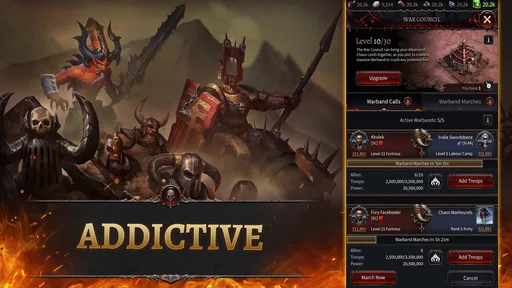
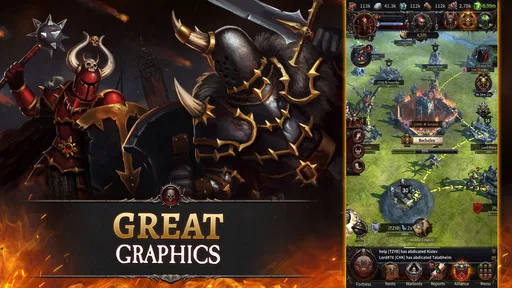
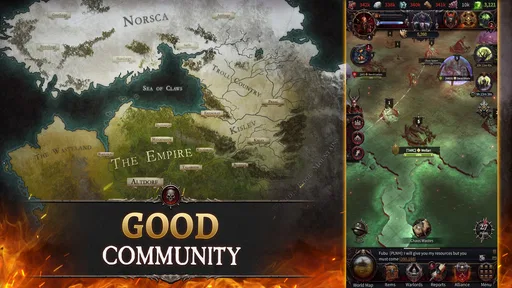
 Analysis by AppCompare
Warhammer: Chaos & Conquest is a strategy game that puts me in charge of building a force, working with an alliance, and protecting a citadel while rival powers compete for control. My first impression was that it is less about winning a single quick battle and more about making a chain of sensible decisions: what to improve, which troops to prepare, when to spend resources, and how much I should commit to a larger conflict.
That makes it a good fit if you enjoy games that continue to develop between play sessions. I can check progress, make a few adjustments, and return later with a clearer plan. It is not the best choice if I want an action-heavy Warhammer experience where every moment is controlled directly. Here, the satisfaction comes from preparation, timing, and seeing a longer strategy begin to work.
What the game feels like when you begin
The game comes from Tilting Point and sits firmly in the strategy category. Its Warhammer setting gives the decisions more character than a completely abstract kingdom builder would have. The citadel is not just a menu screen in my mind; it becomes the center of my priorities, the place I return to when deciding whether to strengthen my position or prepare for a more ambitious move.
The free entry point is helpful because I can try the basic rhythm without committing money first. The game includes optional purchases ranging from $0.99 to $99.99 per item, so I treat spending as a choice rather than part of the installation process. My advice is to play through the opening with a firm resource plan before buying anything. That gives a new player a better sense of whether the ongoing strategy suits them.
The Teen content rating is worth keeping in mind for families. This is a war-themed game with conflict at its center, not a gentle city decoration app. The tone and subject matter are aimed at players who are comfortable with fantasy warfare and competitive pressure.
Its audience is already substantial, with over one million installs, an average rating of 4.4, around forty-six thousand ratings, and roughly four thousand reviews. Those figures suggest that the basic concept has found a committed audience, but they should not replace personal testing. Strategy games can feel very different depending on whether I enjoy long-term planning or prefer immediate control.
The right mindset for a first session
I would not approach this as a game I must completely understand in a few minutes. The opening introduces several connected responsibilities, and the temptation is to tap every available option simply because it is highlighted. I had a better experience when I paused after each new choice and asked what it would improve: my defenses, my ability to field a force, or my position in a wider conflict.
Worth Reading Before You Choose

EA SPORTS FC Mobile 26 Is a Bigger Football Game, but It Takes Time

Flipboard Shows What News Apps Must Do Beyond the Feed

Switching to Android Auto Means Rethinking Your Driving Routine

Google Calendar Makes a Crowded Week Easier to Manage

Ludo King Makes the Most of the Minutes Between Plans

Baby Panda World Brings Quick Play to Modern Phones, but Its Game Library Feels Busy
A useful early habit is to keep one short-term goal in view. For example, I might focus on making the citadel safer before chasing a larger military objective. This prevents the opening from becoming a collection of disconnected upgrades. It also makes the first successful outcome feel earned, because I can identify which decisions helped rather than assuming that progress happened automatically.
The game is currently at version 5.0.1 and requires Android 8.0 or later. That makes checking device compatibility a sensible step before downloading, especially if I am using an older phone or tablet. On a supported device, I still recommend beginning when I have a few uninterrupted minutes, since the first session is more useful when I can read prompts and understand the relationship between the different parts of the base.
From installation to a meaningful first win
I find the first satisfying win comes from understanding what my citadel can support, rather than picking the biggest-looking objective. In this section, I’ll focus on how to turn the opening choices into a deliberate first step, then the next heading looks at the habits that can quietly derail that progress.
Start by learning the shape of your citadel
After installing, I would resist the urge to treat every available action as equally important. The citadel is the anchor for the early game, so I first look at what is already available and what the game is asking me to improve. The aim is not to create a perfect layout immediately. It is to understand which choices support survival and which ones prepare me for expansion.
This distinction matters because a new player can easily spend attention on attractive military options while leaving the foundation underdeveloped. I prefer a balanced opening: make the initial improvements the game recommends, inspect the military side, and then return to the citadel before committing to an ambitious fight. That sequence reduces the chance that I will reach a battle with an impressive-looking force but a weak home position.
When a tutorial points me toward an upgrade or task, I use it as a lesson about priorities rather than a command to follow forever. Early guidance is useful for learning the controls, but later decisions require judgment. If I simply repeat the first pattern, I may waste resources on improvements that do not match my next objective.
Build toward the first successful action
The first meaningful success should be more than collecting a reward from a menu. For me, it is completing an early objective while keeping enough resources and defensive awareness to continue afterward. Before starting, I check what the action requires and whether it will leave the citadel exposed or delay an upgrade that I consider more urgent.
A practical workflow is to prepare first, act second, and review third. I prepare by checking the available force and the state of the citadel. I act by choosing the objective that matches my current strength instead of selecting the most dramatic option. I review the result by asking what changed and whether the reward supports my next improvement. This simple loop is more valuable than rushing from one highlighted button to another.
The game’s alliance element also changes how I think about success. I do not see an alliance as something to join only after I have mastered everything alone. Cooperation can give the wider strategy more meaning, especially when the game’s conflicts extend beyond my individual citadel. At the same time, I would choose an alliance whose activity level matches mine. A highly active group may expect regular participation, while a quieter group may be less demanding but offer a slower social rhythm.
My first recommendation to a newcomer is to join only after understanding what the alliance screen and related objectives ask from me. That avoids agreeing to expectations I cannot meet. It also makes the first contribution more deliberate: I can support a shared goal instead of joining merely because an invitation appears.
A realistic everyday play pattern
Imagine that I have ten minutes during a commute or lunch break. I open the game, check the citadel, collect what is ready, and look at the next improvement rather than starting a random battle. If a military objective fits my prepared force, I take it. If not, I queue a useful development task and leave with a clear reason to return.
Later, when I have more time, I can examine alliance activity and decide whether a larger commitment makes sense. This two-speed approach suits the game well. Short sessions handle maintenance and planning, while longer sessions are better for understanding conflicts and making decisions that affect several parts of the strategy at once.
The important point is that I do not measure every visit by how many screens I touched. A successful short session may simply be choosing the correct next improvement and avoiding an unnecessary fight. That restraint is one of the less obvious skills the game rewards.
Where new players commonly lose their footing
Early setbacks are useful when I read them as clues about preparation, not as a reason to spend or act more aggressively. I’ll look at the common misjudgments that make the game feel harder than it needs to, before the following section turns to ways of setting priorities once the opening guidance runs out.
Confusing activity with progress
The most common mistake is assuming that constant tapping equals efficient play. It does not. A player can spend resources quickly, start several directions at once, and still end up with a citadel that is not ready for the next challenge. I get better results when I decide which bottleneck is holding me back and improve that first.
If my force is not ready, I do not compensate by repeatedly attempting an objective that is clearly beyond my preparation. If my defenses are the concern, I do not spend everything on offensive development simply because battles are more exciting. The game becomes easier to read when I treat each setback as information about the balance of my current position.
Overlooking the difference between solo progress and alliance play
Another source of confusion is expecting alliance participation to feel like ordinary solo progression. It introduces social timing and shared priorities. My own citadel may be ready for one course of action while the alliance is focused elsewhere. That does not automatically mean the game is failing; it means I need to decide how closely my plans should match the group.
I would also avoid joining an alliance purely for a perceived shortcut. The better reason is that I want the cooperative layer to be part of my routine. If I prefer complete independence and dislike checking shared objectives, a more traditional solo strategy game may suit me better.
Misreading optional purchases
The presence of in-app purchases can make a new player feel pressure to spend before understanding the economy. I think that is the wrong order. I would first learn what the normal progression feels like, identify which resources I regularly run short of, and decide whether spending would improve enjoyment or merely remove a moment of planning.
Players who dislike free-to-play systems should approach carefully, even though the game is free to download. The purchase range is broad, and the competitive strategy setting can make optional spending feel more noticeable than it would in a purely cosmetic game. I would recommend setting a personal limit before beginning and treating that limit as part of the strategy, not as an afterthought.
Expecting a traditional action game
The Warhammer name may lead some players to expect direct battlefield control, fast reactions, or a campaign built around individual heroes. This experience is more concerned with managing a broader war effort. I make decisions before conflict and live with their consequences afterward. That can be satisfying, but it will disappoint anyone looking for constant hands-on combat.
Compared with a standard base-building game, the alliance and Warhammer framing give the long-term choices a stronger sense of purpose. Compared with a direct tactical battle game, however, it offers less moment-to-moment control. I prefer this title when I want to plan around a growing citadel and a wider conflict; I would choose a more action-focused alternative when I want every attack and movement to depend on my immediate input.
How to make the next stage feel less overwhelming
As the number of choices grows, I get more from the game by keeping a clear question in mind: what weakness am I addressing with this decision? I’ll cover practical ways to keep development manageable and make alliance involvement fit my routine, leading into when this slower, planning-led style is a good match—and when I’d choose something else.
Choose one development question at a time
Once the opening tasks are complete, I stop asking, “What can I upgrade?” and start asking, “What problem am I solving?” The answer might be that I need a stronger defensive position, a more capable force, or better preparation for alliance activity. This wording keeps the available choices connected to a purpose.
I also keep a small mental reserve instead of spending every resource as soon as it becomes available. That reserve gives me flexibility when an objective appears or when I realize that an earlier decision has created a new weakness. It is a modest habit, but it prevents the frustrating cycle of being ready in theory and unable to act in practice.
Use alliance involvement as a planning tool
Alliance play is most useful to me when it changes how I schedule decisions. Before committing to a shared objective, I check whether my citadel and force can support it without abandoning my own basic development. If the answer is no, I would rather strengthen my position and participate later than make a weak contribution that leaves me behind.
This is also where communication style matters. A player who enjoys coordinating, checking shared goals, and adapting to group plans will probably find more depth here than someone who wants a completely private campaign. The alliance layer is not merely decoration; it asks me to balance personal growth with collective timing.
Know when the game is not for you
I would skip this game if I want a short, self-contained experience with a clear ending. Its appeal depends on returning to an evolving strategic situation. I would also look elsewhere if I strongly dislike waiting for development, comparing priorities, or dealing with optional purchases in a free-to-play environment.
On the other hand, I would recommend it to a player who enjoys fantasy warfare but wants more planning than a conventional action title provides. It is particularly suitable for someone who likes checking a base, preparing a force, and making decisions that matter beyond one isolated encounter. The best experience comes from patience rather than from trying to force rapid progress.
My final recommendation
After spending time with it, I see Warhammer: Chaos & Conquest as a thoughtful strategy game for players willing to let a larger plan develop. The citadel, military preparation, alliance choices, and defensive concerns work best when I treat them as connected parts of one war effort. The game is free to start, supports devices running Android 8.0 or later, and has enough ongoing structure to make brief check-ins worthwhile.
My strongest advice is to make the first session about understanding priorities, not chasing speed. Complete a manageable objective, review what it taught you, and choose the next improvement around a specific weakness. Keep purchases optional, select an alliance that fits your routine, and remember that the game rewards preparation more than frantic activity.
If you enjoy building toward a victory rather than controlling every second of it, this is a worthwhile Warhammer strategy choice. If you need immediate action, a purely solo campaign, or a game without free-to-play pressure, another genre or format will probably serve you better. For everyone else, the first meaningful success arrives when the citadel, the force, and the alliance begin working toward the same goal.
Pros
- Faithful Warhammer atmosphere with recognizable factions and lore.
- Large alliance system encourages cooperation and coordinated strategy.
- Many upgrade paths let you specialize your city and army.
- Regular events provide extra objectives and rewards.
- Playable on both Android and iOS with cross-platform access.
Cons
- Progress becomes noticeably slower without frequent play or resource spending.
- Long construction and research timers can limit short play sessions.
- The interface may feel crowded for newcomers to strategy games.
- Power differences between older and newer players can be substantial.
- Requires a stable internet connection and may use significant battery.
FAQs for Warhammer: Chaos & Conquest
What is Warhammer: Chaos & Conquest?
Warhammer: Chaos & Conquest is a mobile strategy game set in the Warhammer universe. You build and develop a fortress, gather resources, research upgrades, train armies, and recruit powerful characters to expand your influence. The game combines base management, alliance cooperation, world-map exploration, and real-time battles, so progression involves both careful planning and regular activity.
Is Warhammer: Chaos & Conquest free to play?
Yes, Warhammer: Chaos & Conquest can be downloaded and played for free, but it includes optional in-app purchases. These purchases may provide resources, speed up construction or research, and offer special bundles. It is possible to progress without spending money, although free players may need more patience and consistent participation, especially when competing against highly active or paying players.
Does the game require an internet connection?
Yes, a stable internet connection is required for most, if not all, important features in Warhammer: Chaos & Conquest. Your city, armies, alliances, events, and battles are connected to an online world with other players. Because progress is synchronized with the game servers, the experience is not designed for offline play, and interruptions may affect loading or battle-related actions.
Is Warhammer: Chaos & Conquest suitable for new strategy players?
The game is accessible to beginners, but it becomes increasingly complex as your settlement grows. Early tasks introduce construction, resource collection, troop training, and research, while later gameplay requires stronger knowledge of army composition, commanders, alliances, timing, and protection from enemy attacks. Joining an active alliance is highly recommended because it provides assistance, guidance, and additional rewards.
Does Warhammer: Chaos & Conquest contain aggressive monetization or player-versus-player combat?
Warhammer: Chaos & Conquest includes player-versus-player elements, including competition over territory, resources, events, and strategic objectives. Players can also encounter opponents with larger armies or faster progression. In-app purchases are present and may offer meaningful convenience or advancement benefits. Before downloading, players should be comfortable with online competition, recurring events, timers, and the possibility that spending can influence the pace of progression.


